


The second and third essays analyzed how the fragments of a sound line acquire melodic contours due to the modifications. However, these examples, which have not yet received a finished musical form, were quite insufficient for writing even small pieces. Therefore, S. Filatov-Beckman and composer Elena Sokolovski again decided to arrange a master class for the students.
Mathematical music as a new means of developing compositional skills
The Fourth Essay
The composer decided to demonstrate to the students the very process of creating a full-fledged piece and proposed to make this piece purely homophonic, that is, to use a type of presentation in which there are a melody and an accompaniment (later on, there was planned a master class on composing the polyphonic music). This decision to compose the homophonic, melodic music was entirely in line with the students' previous practice, since they worked on the selected fragments of the computer sound line and on the composition of melodies based on these selected fragments. Being present at this process, carefully observing it and directly participating in it, S. Filatov-Beckman describes all this in his notes in sufficient detail.
Let's suppose that there was made a decision to compose a piece of a lyrical, unhurried nature, and the computer sound line No. 1 was chosen for this work. The melody for the piece should have been created from such fragments of the sound line, which are built on the stepwise moves without sharp jumps. They can outline terts-sext profiles.
The selected monophonic fragments should be metrically defined and rhythmically transformed, for example, by using the technique of increasing the durations in a certain fragment of the computer line, in order to select and accentuate the most important sounds (this technique was demonstrated in example No. 12 of the Second essay). In this case the register-octave transfers of the fragment parts and of the individual sounds of the computer line are possible. We give the examples of the selected fragments.

Their metro-rhythmic and octave-register modifications turn into monophonic melodic phrases (sentences).
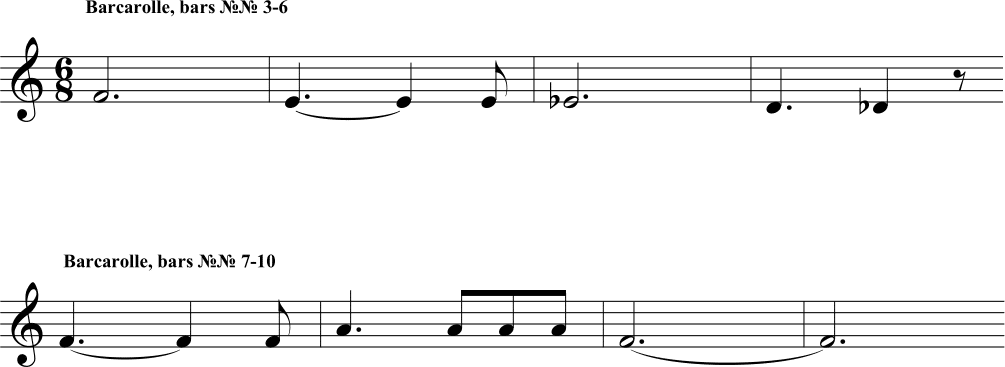
When two melodic phrases are connected horizontally, a rather extended melody of a calm lyrical nature is created, set out in the musical form of the period.
What genre features does the resulting melody possess? It is similar to a song. Such a melody can be found, for example, in the genre of a lullaby, a song «on the water», in a lyrical or urban romance, and so on. The composer chooses the genre of barcarolle.
It is necessary to create an accompaniment to this melody. Apparently, its time signature at 6/8 provides a characteristic impetus to the accompaniment and can emphasize the effect of smooth «wiggle», which is typical for the barcarolle genre.
Having chosen any fragment from the computer line No. 1, one should carry out the same actions that were executed, while composing the melody. The chosen fragment, thanks to its meter-rhythmic transformations and octave-register transfers of sounds, turns into a completely different figure. We adduce a fragment from the computer line No. 1 and its modification, which serves as an accompaniment to the melody.

The connection of the melody with the accompaniment creates a verse, which is often found in the song «on the water» (two measures of introduction are added to the verse). In this verse, the composer accurately observed all the sounds of the computer line and composed mathematical music in the genre inherent in the barcarolle. This small fragment of the pieces possesses a lyrical light character, a slow and calm pace. When performed on the piano, this verse sounds quite expressive.

The verse of the song needs to be continued. What is this sequel? These can be instrumental «ritornels» that follow the verses of the song. If the verse itself is of a «vocal» nature, then the ritornel, most likely, should be «instrumental». The composer decided to write three verses and separate them from each other as if by «guitar ritornels».
The intervals and chords of the ritornels are also formed from the fragments of the computer line: small horizontal fragments are verticalized, that is, they are taken at the same time. The bass in this section brings a new harmonic color: the «B-flat» sound changes to «B-becar», continuing to lead the «wiggle» figure. We give some examples from the computer line and their modifications in various parts of the piece.
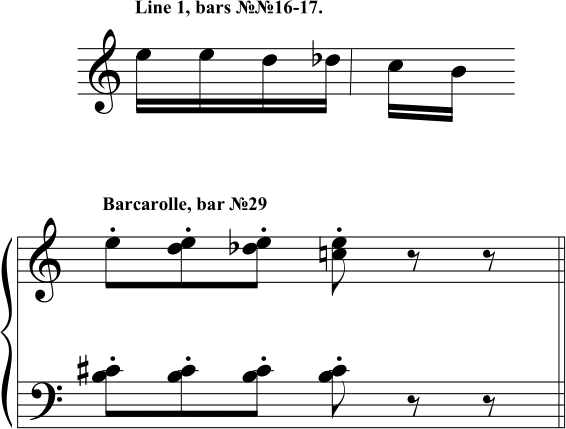


The «guitar» arpeggio at the end of each ritornel is interestingly solved. It directly quotes a sequence of sounds from the computer line, but with each subsequent move it lengthens by two sounds (this is reflected in the diagram).

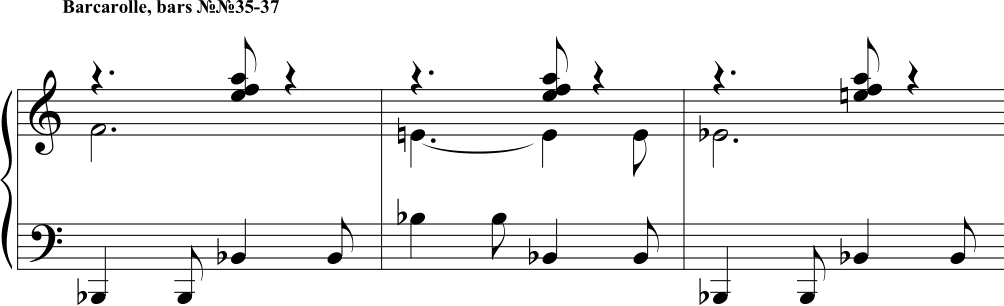
The verses are subject to slight variation. In the second of them, a polyphonic technique was used - a vertical rearrangement of the melody and accompaniment (the same technique was used in the second ritornel). Between the first and second verses, a duet of female and male voices appears, as it were.
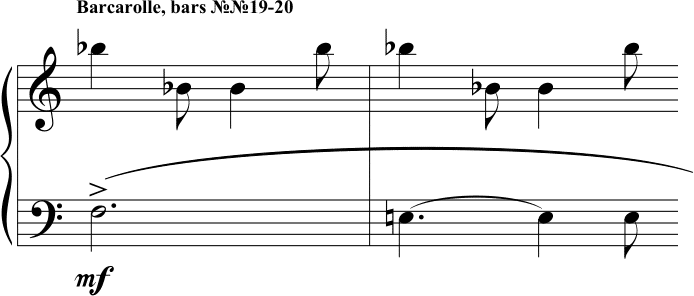
The accompaniment also uses variation - it not only changes the register in the second verse, but extends the «ups» by an octave in the third verse and slightly changes the pattern of the «waves» in the second and third verses. We give an example of the third verse.
The musical form of a piece created by a professional composer has its own peculiarities. A verse form was built therein, which reflected the contrast of «vocal» and «instrumental» principles, characteristic of the song genre.
At the same time, the variational principle was used here (mainly in the texture). In addition, the features of a three-part form appear in the piece - holding the melody in the middle, then in the lower and again in the middle register creates a feeling of reprise.
The first example of the birth of mathematical music from a computer line in the form of a piano piece was a victory - the appearance of this piece proved that the mathematical music in the form of complete pieces is quite possible! This result inspires hope that beginning composers will gradually be able to repeat it - there are quite good reasons for this. The piece "Barcarolle" was the first example of the fourth stage.
We offer you to listen to a piece «Barcarolle».


