


For some time, the students pondered the decision to create a piece that would include polyphonic devices, but would not be composed in a fugue form. S. Filatov-Bekman again turned to the composer Elena Sokolovski for advice.
Mathematical music as a new means of developing compositional skills
The Ninth Essay
Meetings, as usual, were held at the home of S. Filatov-Beckman. The participants discussed the genre of the future piece: the genres of march, nocturne, toccata, lullaby, scherzo, mazurka and so on were proposed. After a certain period of time, a joint decision matured to compose a piece in the scherzo genre for piano.
The work began with the definition of the genre features of the future scherzo, for example, rapid pace, sharp jumps, unpredictable movement. It was also necessary to determine the general figurative character of the piece. It could be joyful or gloomy, light and flighty or tense. It was decided to dwell on the image that outlined the nature
of the rapid, anxious movement. Further, the computer sound line No. 1 was chosen to create the piece.
The sudden sharp and loud consonance with which the piece begins immediately attracts the attention of the listener. It is built on individual motifs selected from a computer line, which are then verticalized. At the same time, motives should consist of at least two or three sounds, which corresponds to the sequence of sounds in the computer line. It is unacceptable to use an arbitrary sound in the formation of motives. The location of the sounds themselves in the resulting consonance is free, which means that these sounds are arranged vertically in a free order.

Rapid roll-call of motives in different registers, syncopated rhythm, sharp rises and falls of the melody draw a very tense, anxious beginning of the piece.

The initial motive, varying, becomes more and more insistent, it seems to be approaching the listeners from somewhere with each performance, and in the reprise of the piece it sounds especially active:
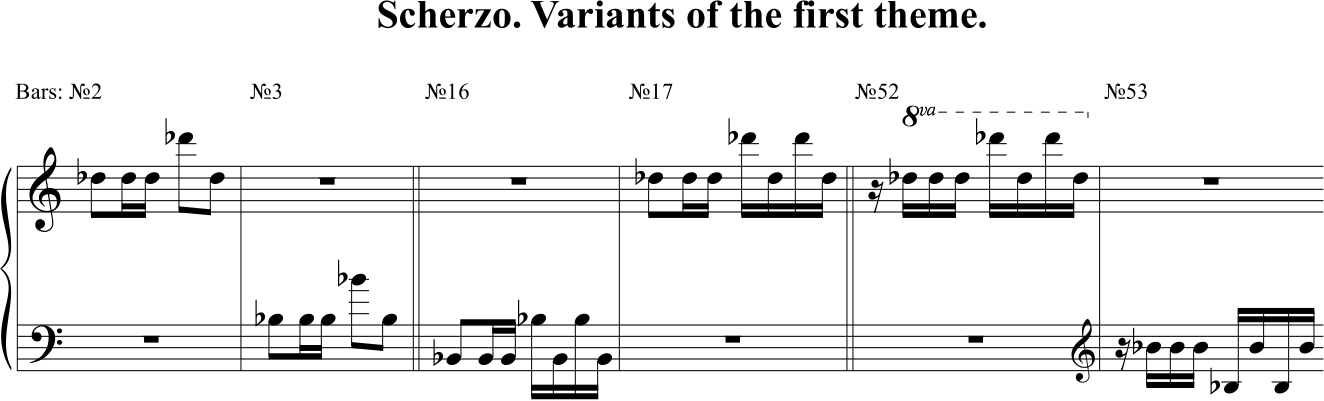
The climaxes are built on an imitation-polyphonic technique: the canon between the upper and lower voices evokes a feeling of chase (the sounds are taken from the measures 10-11 of the computer line).

The culminating canon passage in the scherzo reprise expands to 12 measures and covers a range of more than four octaves, “falling through” into a deep lower register. The last motives of the piece sound quite gloomy. The first part of the scherzo (as well as the reprise of the three-part musical form) convincingly reproduces the “unpredictability” and discontinuity of the rapid movement.
A small middle part stands out strongly against the background of the “restless” extreme parts. Slow movement, repetitions, measured gradual layering of consonances draw a completely different image than at the beginning. The ostinato rhythm and quiet beats of consonances evoke an association with a mysterious bell ringing that occurs somewhere far away, in a haze. Sounds approach, and then melt away, moving away and drawing some mysterious, fabulous images.
The shape of the middle is somewhat unusual: it is built on the principle of mirror-inversion movement. In the initial seven-measure of the middle of the piece the consonances gradually arise from the initial sounds of the computer line, that is, they completely observe its order, and in the final seven-measure they are repeated in the reverse order. Such a structure is reminiscent of the images of “reflections in the water”, found in Russian music and in the work of impressionist composers. Only in this case, this “reflection” is carried out horizontally, and not vertically.
How are these consonances built? In the measures 34-39 of the piece, verticals from two to six sounds are born from one sound “do”. These sounds are switched on from the computer line one by one (measures No. 2-8 of the computer sound line).
In the center of the middle (measures 40-44 of the piece) there are two recurring consonances that make up the “quiet” climax. We adduce the motifs of the sound line chosen for these consonances, and the consonances themselves, where the motifs are verticalized.
Motifs for the first consonance.

Does not the technique of the mirror-symmetrical movement disrupt the sounds of the computer line in the middle section of the piece? This technique of the inversion movement is possible in rare cases, since it is unacceptable to change the order of sounds within a fragment of the computer line. But sometimes the entire fragment itself can be taken in a symmetrically mirrored form – after all, the sounds remain the same.
The experience of composing different and completely dissimilar pieces (Barcarolle, Scherzo) on the basis of one computer line indicates that there can be a large number of various examples of mathematical music. The composer sets himself the task of creating one or another figurative-genre appearance of the piece and, thanks to the consistent actions, he receives full-fledged mathematical music in the form of a piece from a computer line. We offer you to listen to a piece in the scherzo genre for piano.


